Capability Convergence When All Code Is Perfect the Real War Begins
Musk's self-driving analogy for coding AI reveals the deeper signal: when capability converges, taste is the only moat.
In this signal
- 1. Three Months, Three Leaps — This Is Not PR, It's an Engineering Commitment
- 2. The Self-Driving Analogy — A Metaphor That Deserves More Attention
- 3. When Models Converge, Infrastructure Becomes the Only Variable
- 4. Ecosystem Stickiness — The Overlooked Second Front
- 5. Taste — The Last Moat
- 6. After Convergence, the Word "Programming" Itself Will Change
- 7. What This Tweet Is Actually Saying
"By then, like a self-driving car that drives perfectly, it will be hard to tell the difference between the leading coding models, as they will so rarely get anything wrong."
— @elonmusk
We are witnessing the final act of an arms race.
Not because a player has dropped out — but because the track itself is disappearing. Last week Musk casually dropped Grok's coding-model catch-up timeline on X: close by April, on par by May, surpassing by June — all anchored to Colossus 2 reaching full operational capacity. But the timeline is not the real signal. The real signal is the analogy he reached for: self-driving.
When every car drives perfectly, nobody asks "which one is safer."
That sentence has a longer range than a tweet.
1. Three Months, Three Leaps — This Is Not PR, It's an Engineering Commitment
April: close. May: on par. June: ahead.
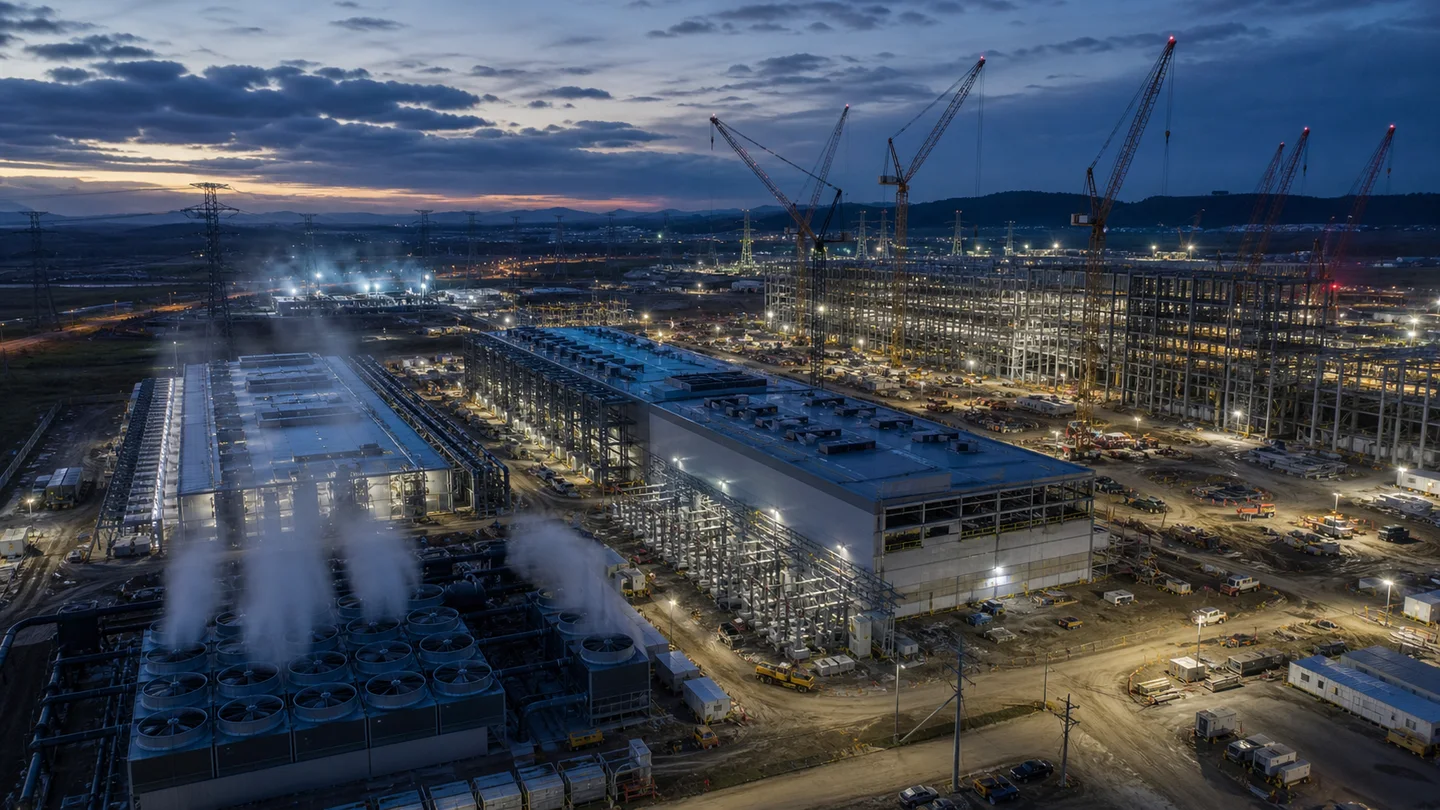
Concept illustration | Repeated expansion turns a model roadmap into an infrastructure commitment
Notice the granularity. Musk did not say "we're working hard" or "the future looks bright." He gave month-by-month delivery milestones. This is language spoken in front of a Gantt chart, not a camera.
And the foundation under that timeline is a physical object — Colossus 2, xAI's supercomputing cluster. When he says "surpassing by June," he is not saying "our algorithms will be smarter." He is saying "our data center will be fully online."
That is a critical distinction. Algorithmic breakthroughs are unpredictable. Data center deployments can be scheduled.
2. The Self-Driving Analogy — A Metaphor That Deserves More Attention
Musk using self-driving to frame coding AI was not a throwaway line. He is among the people on Earth who understand autonomous driving most deeply. His choice of analogy is itself a signal.
The history of self-driving taught us one thing: when the error rate approaches zero, differentiation stops happening at the capability layer. In 2015, people debated which company's self-driving was "better." By 2025, the question became: whose in-car experience is smoother, whose ecosystem is more complete, whose insurance is cheaper.
Capability did not disappear. It became table stakes — not a competitive advantage, but a competitive prerequisite.
Coding models are walking the same path. When Grok, Claude, GPT, and Gemini all write near-perfect code, "whose code is better" ceases to be a meaningful question — just as no one today cares which calculator computes 1+1 more accurately.
3. When Models Converge, Infrastructure Becomes the Only Variable
This is the chess game Musk is actually playing.
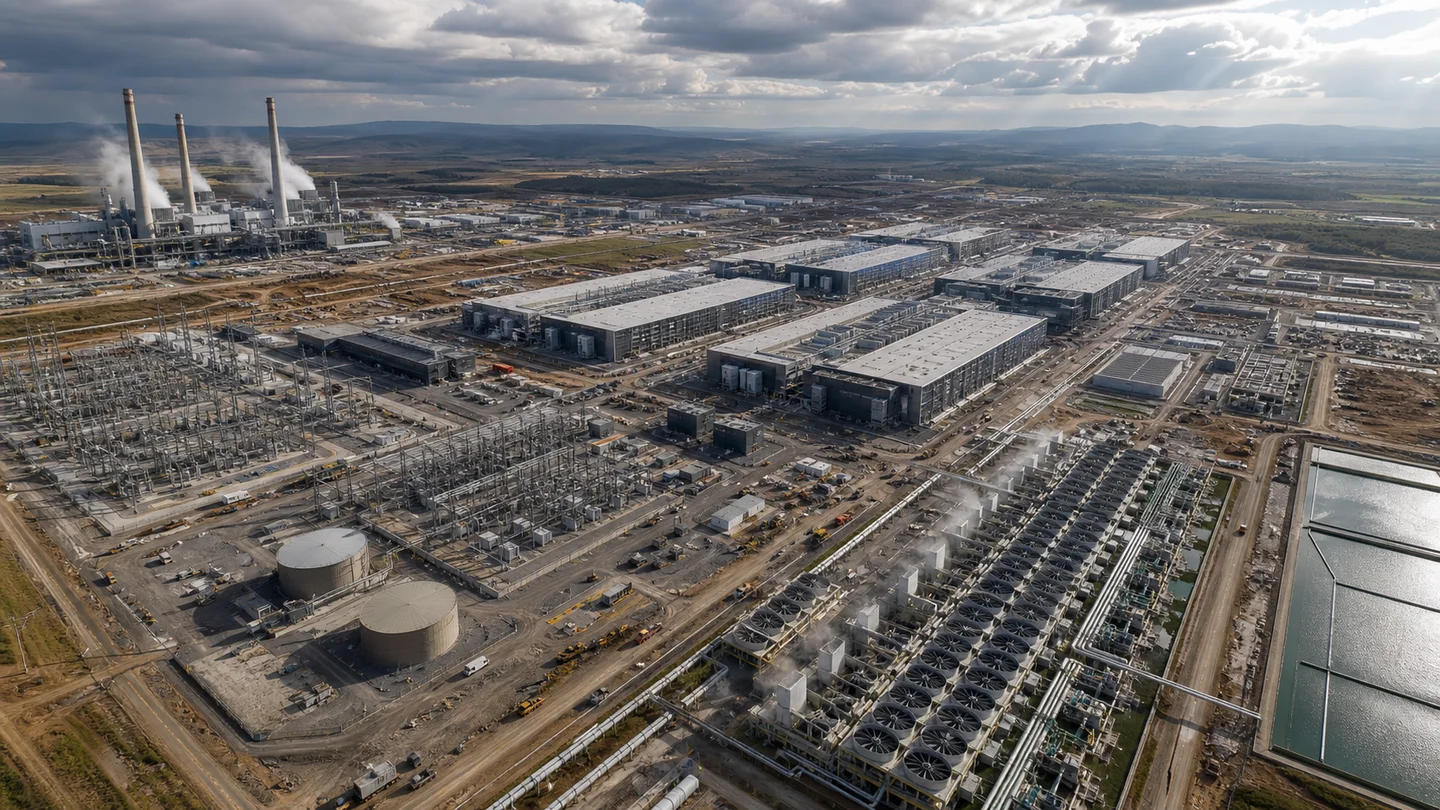
Concept illustration | As models converge, power, chips, and cooling become primary variables
Capability convergence is not the endpoint — it is the starting gun. Competition gets pulled from the model layer down to the infrastructure layer. Whoever owns the largest GPU cluster holds a slim but decisive edge at the convergence point. Faster inference, lower cost, shorter latency.
The logic behind xAI building Colossus 2 suddenly snaps into focus: he is not betting that models will get smarter. He is betting that models will get equally smart. And in a world of equal intelligence, whoever's compute is cheaper wins.
This is not a war over intelligence. It is a war over electricity, chips, and cooling.
4. Ecosystem Stickiness — The Overlooked Second Front
Above infrastructure, there is a subtler layer of competition: ecosystem.
Whose toolchain flows more smoothly? Whose Agent framework is more mature? Whose developer experience — from IDE plugins to API docs to debugging workflows — makes you feel like you "can never go back"?
This is not a technology question. It is a product question. More precisely, it is a habit question. When all models write equally well, developers will not choose "the strongest." They will choose "the most familiar."
5. Taste — The Last Moat
This is the most counterintuitive layer of the entire analysis.
When every AI can write correct code, who can write elegant code? When all answers are right, which answer is more beautiful?
This sounds like an aesthetic question, but it is actually a business question. Elegant code means lower maintenance costs, higher readability, less technical debt. In a capability-converged world, taste is not a nice-to-have — taste is the only differentiator.
Musk's self-driving analogy reaches its maximum range here: when every car drives perfectly, you stop choosing based on "will it crash" and start choosing based on interior design, brand, and feel. That is taste.
6. After Convergence, the Word "Programming" Itself Will Change
This is the part that should make you uneasy.
If all models can perfectly translate human intent into code, then the bottleneck is no longer "writing code" — it is "expressing intent." The core skill of programming will shift away from syntax, algorithms, and architecture toward an older, more human capability: knowing clearly what you want.
This recalls what happened after the printing press became widespread. When "copying text" became cheap, the bottleneck shifted from scribes to authors. Rising literacy did not kill writing — it redefined writing. Likewise, the capability convergence of coding AI will not eliminate programmers, but it will redefine what "programmer" means.
The programmer of the future may look more like a director than an actor, more like an architect than a bricklayer.
7. What This Tweet Is Actually Saying
On the surface, Musk is saying Grok is catching up.
One layer down, he is saying the coding model arms race is about to end.
One layer deeper, he is saying xAI has shifted its bet from models to infrastructure.
And at the very bottom, he is — perhaps unintentionally — pointing at a larger picture: when machines write code as easily as humans write words, what becomes truly scarce is not capability but direction.
Not who can write, but who knows what to write.
Not a war of compute, but a war of taste.
Not the endgame of technology, but the return of the human.
Don't Panic. Accelerate.