The Moon Is an Unawakened GPU The Endgame for Compute Isn t on Earth
Every civilizational leap begins with redefining a resource. The Moon is not a destination — it's a dormant compute mine.
In this signal
Every civilizational leap begins with redefining a resource.
The agricultural age redefined land — from hunting ground to farmland. The industrial age redefined heat — from warmth to power. The information age redefined sand — from building material to semiconductor. And what's happening right now is a redefinition of the nearest celestial body: the Moon is not a destination, not a colony, but a dormant compute mine.
At xAI's all-hands, Elon Musk said one sentence: "You must go to the Moon." He wasn't talking about planting flags. He was talking about AI's energy crisis — not biological survival, but the power ceiling of digital civilization.
I. Physics Gives You a Free Lunch
Why the Moon? One word: gravity.
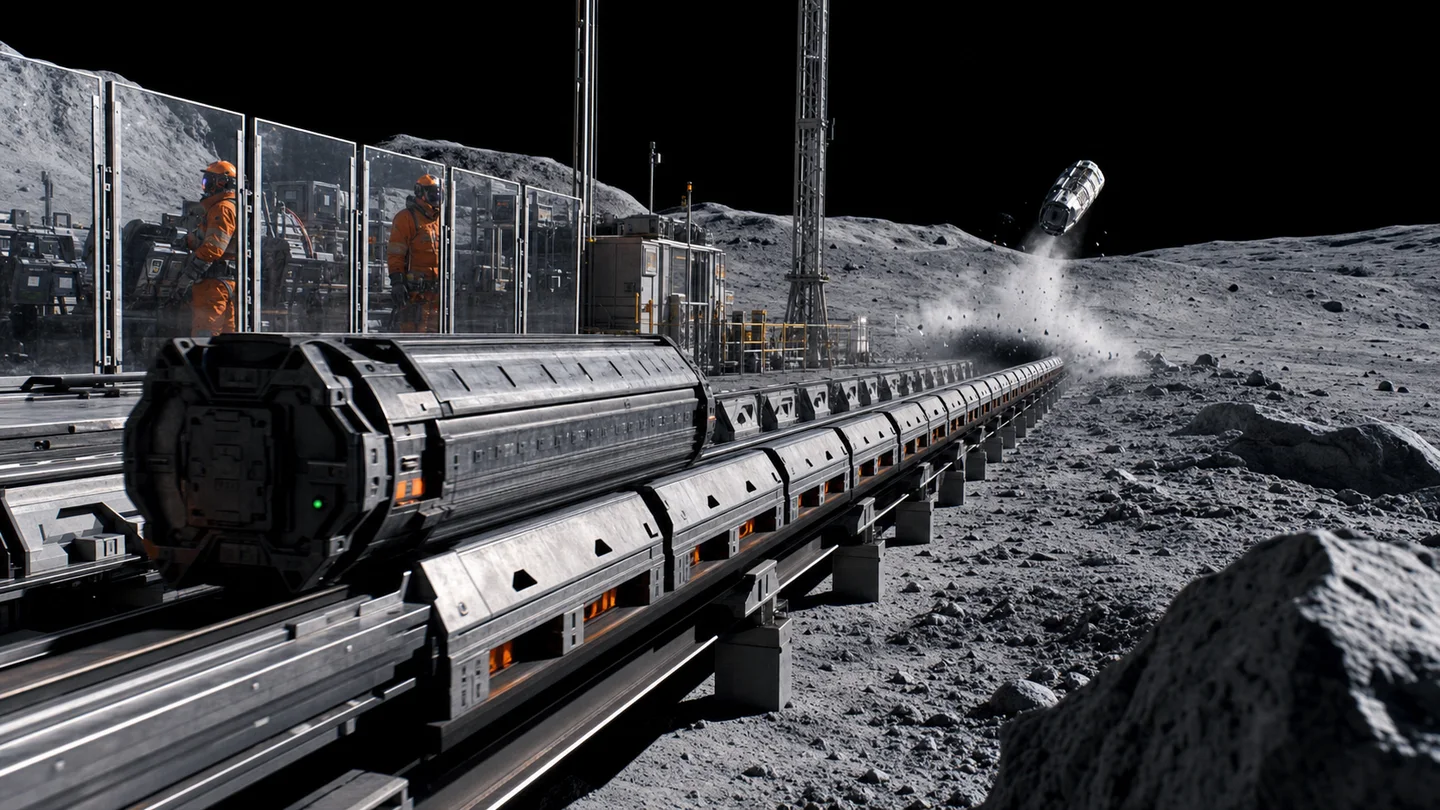
Concept illustration | Low gravity and vacuum give a lunar mass driver a physical advantage
Earth's escape velocity: 11.2 km/s — requires massive chemical rockets. Moon's escape velocity: 2.4 km/s — requires only electricity.
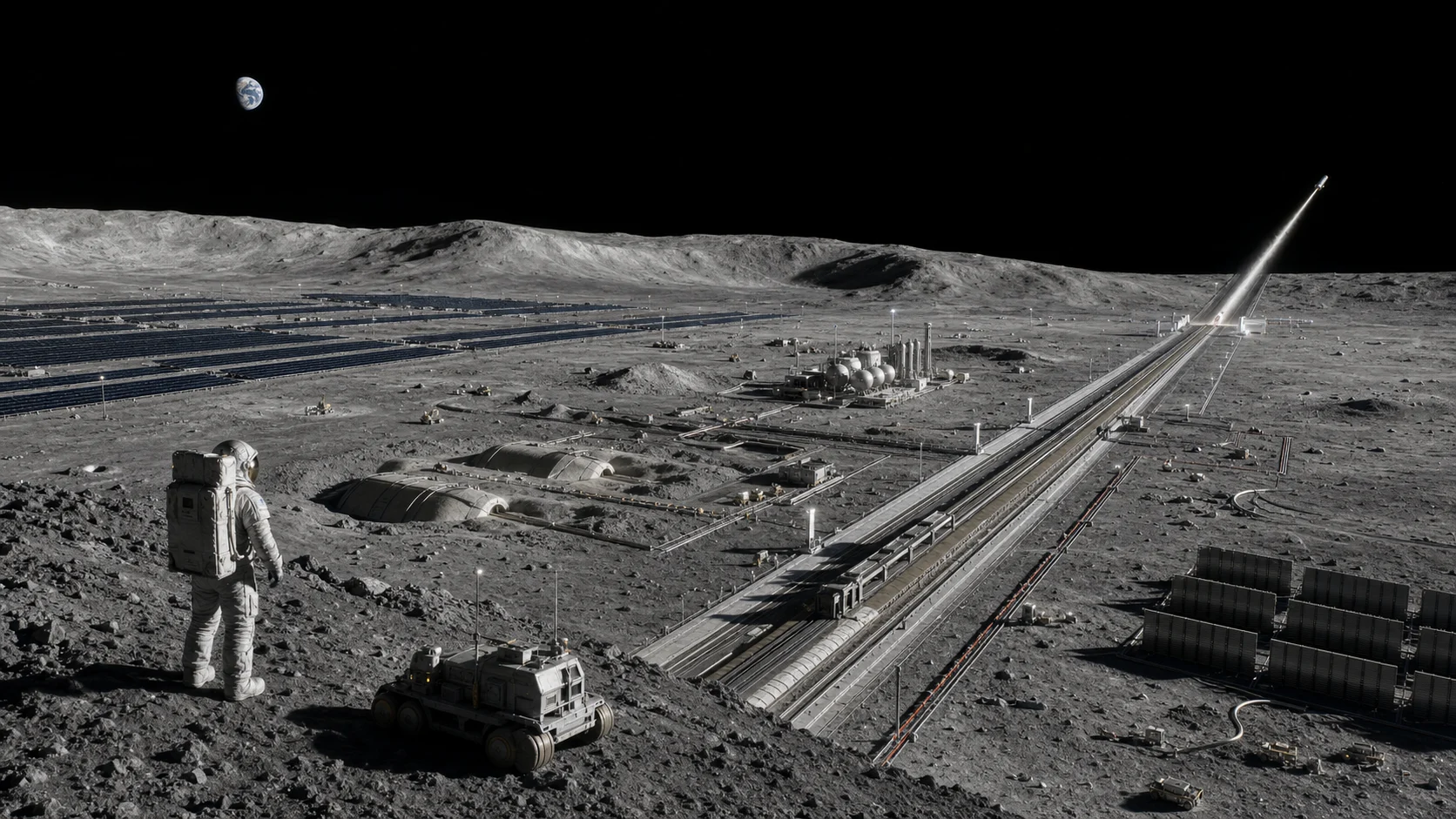
1/6 gravity. Zero atmosphere. No rockets needed. Just a solar-powered electromagnetic railgun.
This is the Mass Driver — a concept Princeton physicist Gerard O'Neill built a prototype for at MIT in 1974. A 160–500m electromagnetic track accelerates payloads to lunar escape velocity. NASA validated the engineering in the 1970s (SP-428, SP-413).
Can electronics survive 1,000–10,000g of electromagnetic launch? Yes. Fuze chips inside artillery shells handle this daily. Military-grade chips withstand thousands of g's as routine. The US Navy's EMALS catapult system launches fighter jets off carrier decks with electromagnetic force every day. Same physics. Friendlier conditions — no air resistance, no weather.
The lunar surface isn't a wasteland. It's a launch pad waiting to be plugged in.
II. Eating the Regolith
The key insight isn't "ship materials FROM Earth to the Moon." It's "grow compute ON the Moon."
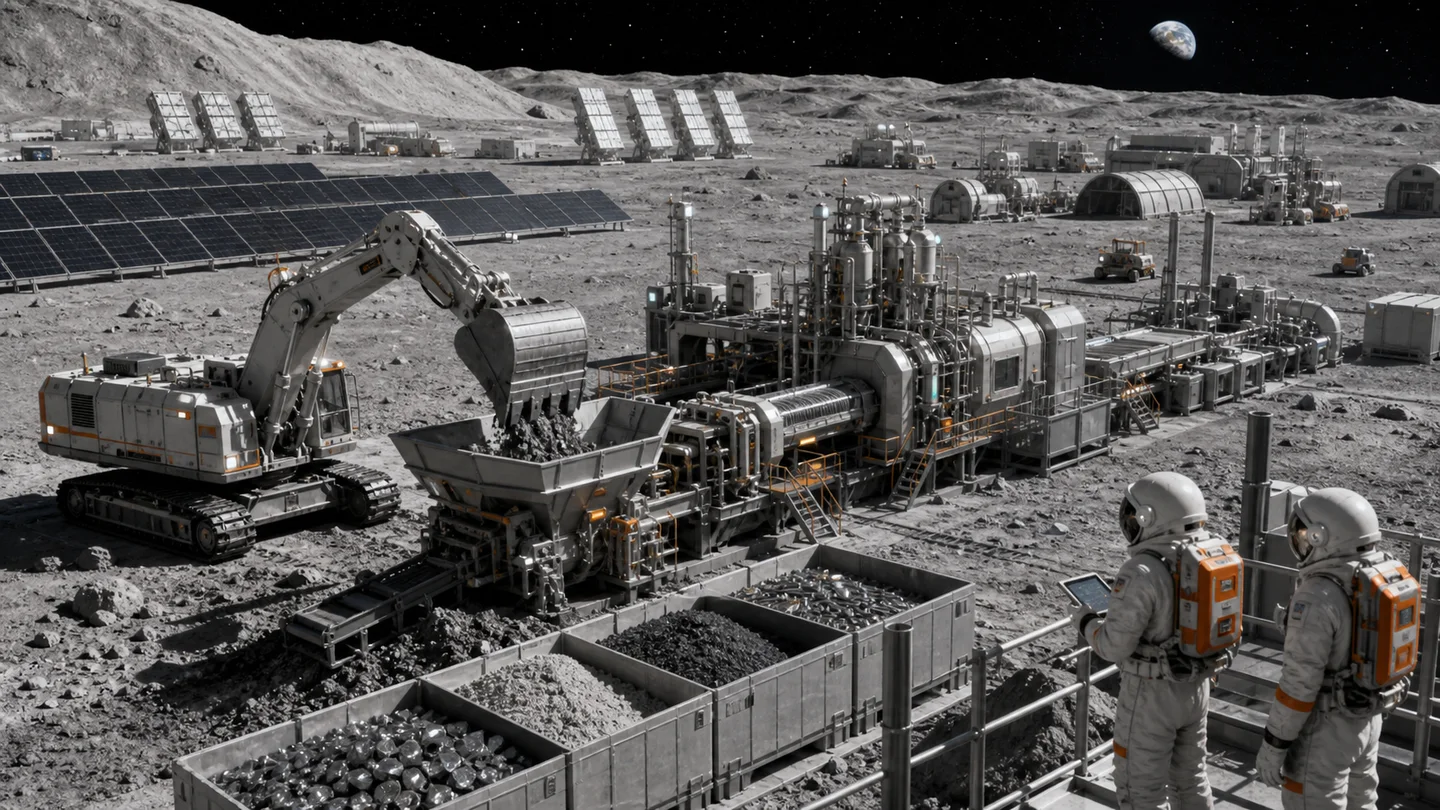
Concept illustration | Regolith becomes industrial feedstock only through excavation, separation, and refining
Lunar regolith contains: aluminum (structural frames, conductors), silicon (semiconductors, solar panels), iron (from titanium-rich ilmenite), and oxygen (a byproduct of metal extraction).
Molten Regolith Electrolysis (MRE) — already demonstrated in labs by NASA and Lunar Resources Inc. — extracts metals and oxygen directly from lunar soil in vacuum.
Picture the production line: autonomous mining robots scoop lunar dust → smelters output silicon wafers, aluminum alloys, photovoltaic panels → AI factories assemble standardized compute units.
The Moon doesn't carry compute. The Moon grows compute.
This isn't "building a data center on the Moon" — it's turning the Moon itself into a self-replicating computational infrastructure.
III. The Space Compute Race Has Begun
None of the above is one company's fantasy. This is a global infrastructure paradigm shift already underway.
Google Project Suncatcher (Nov 2025) — 81-satellite clusters at 650km dawn-dusk orbit. TPU chips onboard. Terabit free-space optical links (1.6 Tbps demonstrated). Orbital solar panels produce 8x the energy of ground-based ones. TPUs survived 3x the expected 5-year LEO radiation dose.
Starcloud (Nov 2025) — NVIDIA-backed. Launched the first H100 GPU to orbit — 100x more powerful than any previous space GPU. Completed humanity's first in-orbit LLM training (NanoGPT). Next: multiple H100s + Blackwell chips by Oct 2026. Long-term: 5 GW space data centers with 4km-wide solar arrays.
SpaceX FCC Filing (Jan 30, 2026) — Applied to deploy up to 1 million orbital data center satellites at 500–2,000km. The filing literally uses the phrase "Kardashev Type II civilization." A commercial company. In an official FCC regulatory document. Citing the Kardashev Scale.
ESA ASCEND Program — Europe is moving too. Led by Thales Alenia Space under Horizon Europe. Feasibility study conclusion: orbital data centers are technically, economically, and environmentally viable.
These aren't dotted lines on a roadmap. These are funded, approved, launched facts.
IV. The Sentient Sun
On Earth, data centers are at war with human power grids.
US DOE (Dec 2024): data center power consumption tripled in 10 years. Could consume 12% of all US electricity by 2028. Only 3 companies globally can manufacture turbine blades — orders booked through 2030.
Musk's warning: "Those who live in software land are about to have a hard lesson in hardware."
Space flips the equation. In orbit: no clouds, no atmospheric absorption, near-permanent sunlight. 8x solar energy. Waste heat radiates into 4 Kelvin deep space vacuum — zero water cooling needed.
Massive orbital AI clusters linked by terabit free-space optics = a computational Dyson cloud wrapping Earth. Musk's name for it: "The Sentient Sun."
Converting stellar fusion energy directly into intelligence. Every watt the Sun throws into the void — captured, routed through GPU and TPU circuits, transformed into thought, reasoning, creation.
Musk's timeline: "In 36 months — maybe closer to 30 — the most economical place to deploy AI will be space."
Within 5 years, SpaceX aims to launch more AI compute annually than the total installed base on Earth. Hundreds of GW per year. Eventually terawatts. ~10,000 Starship launches/year.
This isn't growth. This isn't expansion. This is a habitat migration of compute civilization.
V. An Engineering To-Do List
Tsiolkovsky said: "Earth is the cradle of humanity, but one cannot live in the cradle forever."
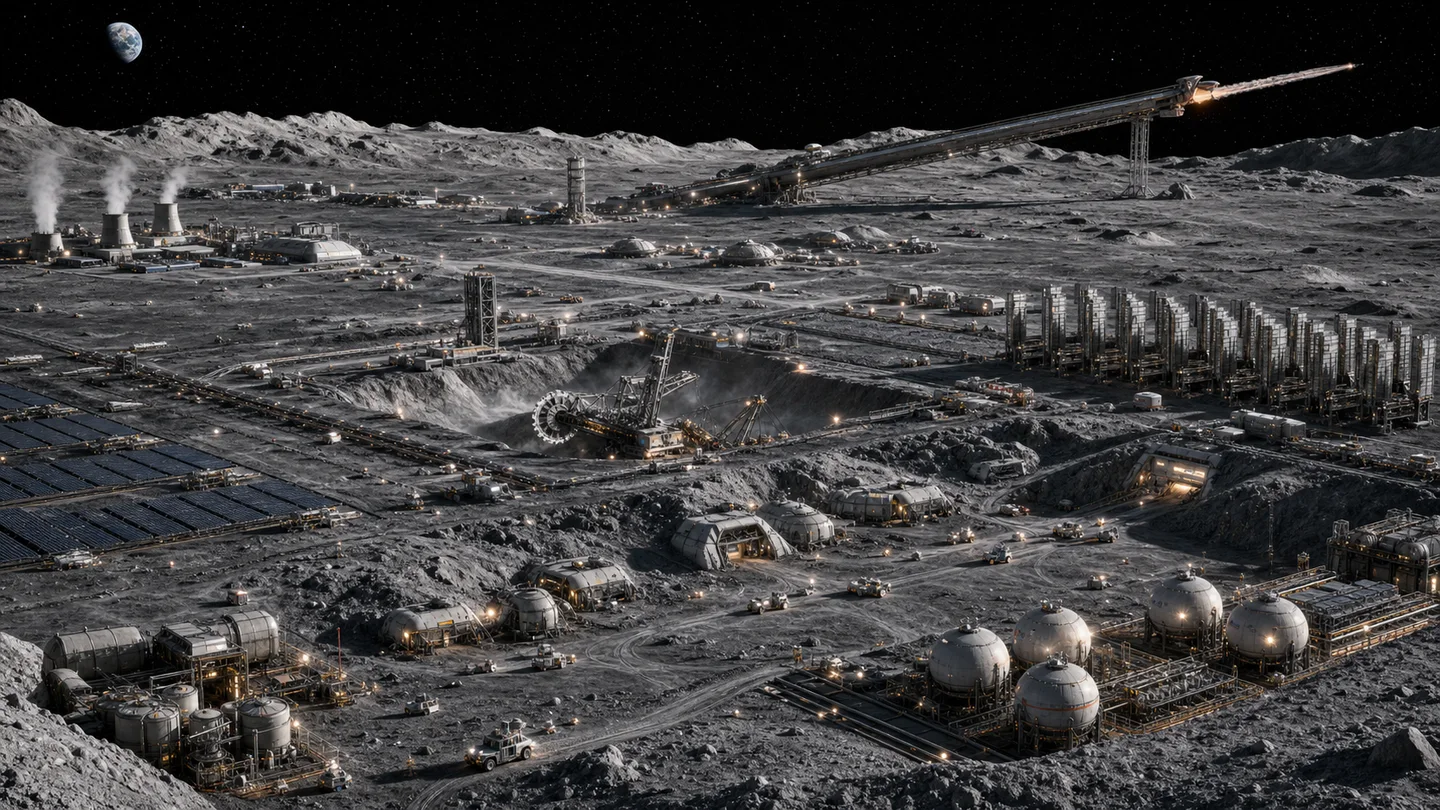
Concept illustration | Lunar compute requires a complete set of interdependent engineering systems
Updated: Earth is the cradle of AI, but AI's energy hunger cannot be sustained by Earth alone.
Moon AI factory + electromagnetic mass driver + orbital data centers. This trinity is a clear path to Kardashev Type II.
Trace the chain: O'Neill 1974 prototype → NASA engineering validation → EMALS combat deployment → MRE lab verification → Starship flying → 6,000+ Starlinks in orbit → TPU radiation testing passed → first space AI satellite launched → FCC million-satellite filing accepted.
Every piece of the puzzle already exists. The question isn't "if" — it's "how fast."
VI. Silicon Independence Day
Everyone's debating how much power AI will consume, where to build data centers, whether nuclear can keep up.
But everyone's missing a quieter signal.
When you lift your gaze from the ground and look up — at the silicon in the lunar surface, at the never-setting sun in orbit, at the natural 4K cooling system of deep space vacuum — you realize that AI's energy problem was never an engineering problem. It was a problem of vision.
The answer was never on the ground. The answer is 384,400 kilometers above our heads, in that body we've gazed at for a hundred thousand years. Its dust holds silicon. Its vacuum holds cooling. Its feeble gravity holds a launch pad to the entire solar system.
When the first mass driver charges in the silent vacuum of the Moon and fires the first AI core forged from lunar dust into deep space — that will be Silicon Independence Day.
The endgame for compute isn't on any continent. It's somewhere you can see just by looking up.
Don't Panic. Accelerate.
Hardware Foundry 001
Turn a low-risk hardware idea into an inspectable feasibility, cost, safety, and manufacturing-readiness case before anyone is asked to scale it.