Gemini 3 Deep Think When Reasoning Becomes Infrastructure
Deep Think isn't 'smarter chat' — it's AI running the middle mile from idea to manufacture. The API opening is the real inflection point.
In this signal
Evidence and limits
Confidence medium真正的变化不是模型又拿到更高分 而是专用推理开始成为研究工作流可以调用和检验的基础设施
Sources
Sources
Could be wrong if
这只是受控演示和品牌发布 尚不足以构成稳定基础设施
Next observation
独立团队复现率 API 可用范围和真实研究成果
Human civilization has a recurring pattern: the technologies that truly change the world never do so at the moment of their invention — they do so at the moment they transform from "showcase" to "infrastructure." Electricity followed this arc. The internet followed this arc. Today, it's the turn of reasoning itself.
Google just shipped a major upgrade to Gemini 3 Deep Think. But the significance here isn't another benchmark getting smashed. It's that a fundamental inflection is underway: AI reasoning is transitioning from a consumer-grade chat trick into research-grade production infrastructure.
1. What Happened
Google expanded Gemini 3 Deep Think from math-and-code specialist reasoning into chemistry, physics, and engineering. Simultaneously — and this is the key — the API opened to developers, researchers, and enterprises for the first time.
A "thinking mode" just became a "thinking pipeline." The distance between those two phrases is the distance between toy and tool.
2. The Capability Sheet: No Longer Smart Chat
- Domain coverage: Broad scientific fields, parallel hypothesis reasoning, and a feature that reads like science fiction — converting hand-drawn sketches directly into 3D-printable files.
- Benchmarks: Humanity's Last Exam 48.4%, ARC-AGI-2 84.6%, Codeforces Elo 3455, gold-medal performance on IMO / IPhO / IChO 2025.
Each number is striking on its own. Taken together, they describe not a "smarter model" but a systematic, cross-disciplinary reasoning capability.

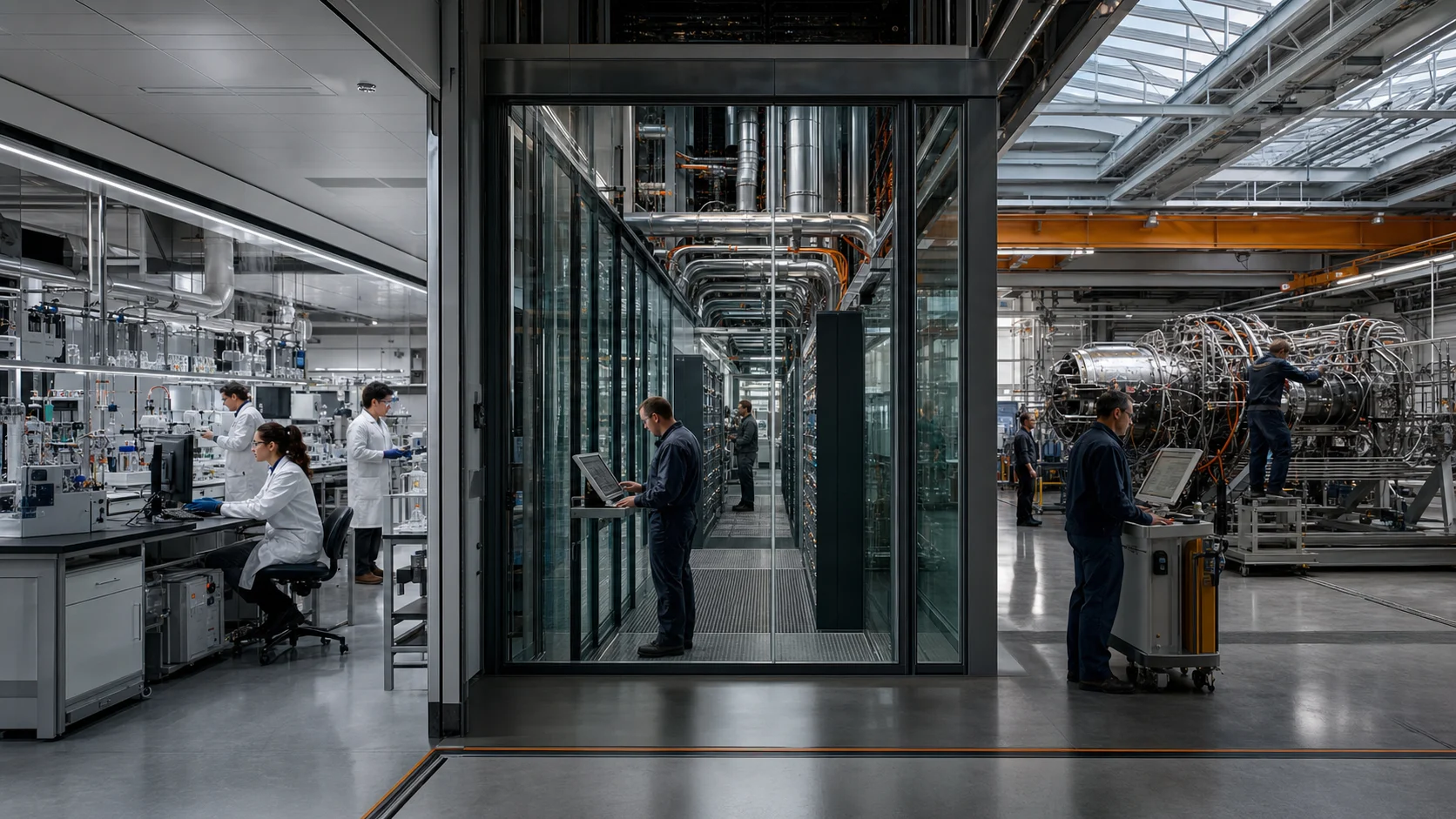
Concept illustration | Reasoning models are extending from answering questions into research and design work
3. Two Real Cases Worth More Than Any Benchmark
A mathematician at Rutgers used Deep Think to review a paper and caught a logical flaw that had slipped through human peer review.
A Duke University research team used it to break through the 100μm barrier in semiconductor thin-film fabrication.
Notice the nature of these two events. The first: AI isn't answering questions — it's auditing human answers. The second: AI isn't simulating experiments — it's optimizing real manufacturing processes.
This isn't "AI-assisted research." This is AI as a structural node in the research pipeline.
4. Who Gets Access, and How
- AI Ultra subscribers ($249.99/mo): Gemini App → Tools → select "Deep Think"
- Developers / Researchers / Enterprises: API now open
- Free users: Not available — limited to Gemini 3 Flash
$249.99 a month. That price point is itself a signal — Google isn't selling a chatbot. It's selling access to research infrastructure.
5. The API Opening: The Real Inflection Point
What was Deep Think before? A premium feature inside a consumer interface. Users clicked a button and waited for a better answer.
What is Deep Think now? A reasoning engine that can be called programmatically, embedded in workflows, deployed at scale.
Why does this distinction matter? Because every technological revolution in history accelerated not at the moment the technology got stronger, but at the moment it became a programmable interface.
6. Idea to Manufacture: The Vanishing Middle Mile
The traditional innovation chain looks like this: idea → research → prototype → testing → manufacturing. The three middle links — research, prototyping, testing — are where the most time, capital, and labor get consumed. That's the "middle mile."

Concept illustration | Reasoning systems may compress the middle steps from idea to manufacturable prototype
Sketches becoming printable files. Papers being auto-reviewed. Fabrication processes being optimized. Deep Think isn't replacing one step in the middle mile — it's compressing the entire middle mile.
When the distance between idea and manufacture compresses, the pace of innovation doesn't grow linearly. It releases exponentially.
7. A Deeper Question
We're witnessing the birth of a new division of labor. Not between humans, but between humans and reasoning systems. Humans pose questions, set direction, make value judgments; reasoning systems execute verification, optimize pathways, compress intermediate steps.
This is not a story about humans being replaced. This is a story about human cognitive bandwidth being liberated.
A thousand years ago, the printing press didn't replace thinkers — it let the speed of dissemination catch up with the speed of thought itself. What's happening today is structurally identical: reasoning infrastructure isn't replacing researchers. It's letting the speed of verification and execution begin to catch up with the speed at which humans generate ideas.
This isn't smarter chat. This is the infrastructuralization of reasoning itself. And once infrastructure is built, what grows on top of it always exceeds the imagination of its builders.
Don't Panic. Accelerate.